
Electric Utility Lineworker
Is this for you?
- You like hands-on, physical work and being outdoors.
- You want a career with purpose, steady demand, and clear pay growth.
- You’re dependable, calm under pressure, and value teamwork and safety.
Why this career is a great choice
Thinking about becoming an Electric Utility Lineworker? Here’s why it’s a great move. You earn while you learn with a paid apprenticeship (usually 3–5 years), and your pay bumps up as you hit each milestone. The compensation is strong—competitive hourly rates plus overtime and storm pay—and in busy years many journeymen clear six figures. Benefits often include healthcare, retirement/pension, and tuition help (actual pay and benefits vary by region and employer).
If you want purpose, this is it: you literally keep the lights on for homes, hospitals, and even new tech like EV chargers and data centers. The work is outdoors, hands-on, technical, and team-based—no desk required.
There’s also a clear path forward: apprentice → journeyman → crew lead/foreman → troubleshooter → supervisor.
Prefer to specialize? Go deep in substation, transmission, underground/URD, or system operations. If you like learning by doing and want a career that pays now and grows with you, this is the one.
 Typical Entry Level Salary
$51,000
Typical Entry Level Salary
$51,000
Source: USEER (2025) Electric Power Generation

Explore Career Details

What the job really is
- Build, maintain, and repair the power lines that keep homes, hospitals, data centers, and businesses running.
- Work on overhead and underground lines: set poles, string wire, splice cable, install transformers and switches.
- Restore power after storms and emergencies—often the first responders for the grid.
- Use bucket trucks, climbing gear, hot sticks, test meters, and sometimes drones to inspect and fix lines.
- Work in crews, follow strict safety procedures, and communicate with dispatch and the public.

A day in the life
- Morning safety brief and job plan; inspect PPE and tools.
- Set up traffic control; operate bucket trucks or climb poles using gaffs and belts.
- Install or replace crossarms, insulators, conductors; terminate underground cables.
- Test and phase lines; follow switching/clearance procedures to de-energize safely.
- Document work in mobile apps; coordinate with dispatch and customers.
- During storms: mobilize for restoration, sometimes traveling to help other regions.

What you will use
- Bucket and digger derrick trucks, pole-setting equipment, cranes/rigging.
- Climbing gear (gaffs, belts), fall protection, live-line tools (hot sticks, rubber gloves).
- Test equipment (voltage detectors, phasing meters, TDRs), splicing/press tools.
- GIS-enabled tablets, digital work orders, drones/thermal cameras in some utilities.

What you need to bring
- Safety-first mindset and teamwork; good communication.
- Comfort with heights, weather, and physical work (lifting, climbing).
- Mechanical aptitude; basic math and electrical concepts.
- Valid driver’s license; ability to qualify for a Class A CDL (often within the first year).
- Pass drug/alcohol and physical screenings; strong attendance and reliability.

Where this career can take you
You can move up on this path:
- Apprentice
- Journeyman
- Crew Lead/Foreman
- Troubleshooter
- Supervisor/Manager
You can specialize your knowledge in:
- Transmission
- Distribution
- Underground/URD
- Substation
- Cable Splicing
You may also be interested in roles like:
- System Operator (control room)
- Protection & Control/Relay Tech
- Distribution Designer
- Safety Trainer
- Vegetation Manager
- Meter/AMI Tech
This career is in these categories:
Ready to explore real openings for this career path?
Career Pathway Resource
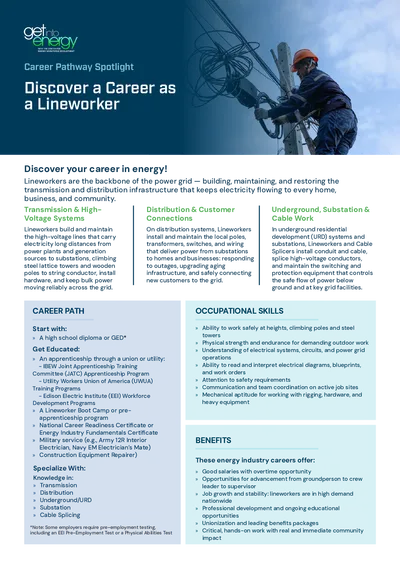
Lineworker
(Click to download)