
Commissioning Engineer
Is this for you?
- You enjoy hands-on testing and troubleshooting.
- You like following procedures and checklists to ensure quality.
- You are detail-oriented and safety focused.
- You enjoy working on-site and seeing projects completed.
Why this career is a great choice
This career is a great fit for people who like hands-on work, problem solving, and seeing projects come to life. Commissioning Engineers step in after energy equipment is built and installed to test, inspect, and verify that everything works the way it should. Using checklists, procedures, and testing plans, they confirm systems are ready for real-world operation.
As you gain experience, you’ll work on more complex systems and take on greater responsibility. Many Commissioning Engineers become technical experts, lead startup teams, or move into engineering management or project leadership roles. It’s a role that sits at the intersection of design, construction, and operations and plays a critical part in keeping energy systems running safely from day one.
 Typical Entry Level Salary
$69,720
Typical Entry Level Salary
$69,720
Source: USEER (2025) Electric Power Generation

Explore Career Details

What the job really is
- Inspect newly installed energy equipment and systems.
- Perform startup tests to verify proper operation.
- Follow commissioning checklists, test plans, and procedures.
- Identify and help resolve installation or performance issues.
- Document results and confirm systems are ready for operation.

A day in the life
- Review commissioning plans, drawings, and test procedures.
- Walk down equipment to confirm correct installation.
- Perform functional tests and system startups.
- Record results and flag any issues that need correction.
- Coordinate with construction, engineering, and operations teams.

What you will use
- Commissioning checklists and test procedures.
- Electrical, mechanical, or control system test equipment.
- Engineering drawings and technical manuals.
- Data recording and reporting tools.
- Safety equipment and lockout procedures.

What you need to bring
- Strong interest in engineering, systems, or technical work.
- Attention to detail and commitment to safety.
- Comfort working with equipment, tools, and data.
- Clear communication and teamwork skills.
- Willingness to travel or work on-site as needed.

Where this career can take you
You can move up on this path:
- Commissioning Engineer
- Senior Commissioning Engineer
- Systems Lead
- Project Manager
- Operations Management Leader
You can specialize your knowledge in:
- Electrical and substation equipment
- Power generation and renewables
- Controls and automation systems
- Mechanical and rotating equipment
- Grid, pipeline, or industrial facilities
You may also be interested in roles like:
- Field Service Engineer
- Controls & Automation Engineer
- Electrical Engineer
- Reliability Engineer
- Operations Engineer
This career is in these categories:
Ready to explore real openings for this career path?
Career Pathway Resource
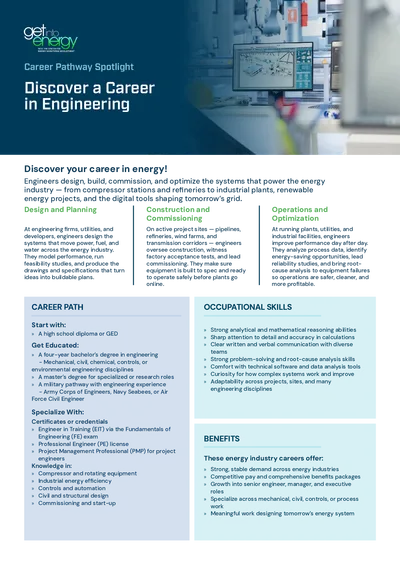
Engineering
(Click to download)