
Petroleum Refinery Operations Technician
Is this for you?
- You enjoy learning how big industrial systems work and appreciate structured environments with clear procedures.
- You feel comfortable analyzing information and reacting quickly when conditions change. You enjoy roles where precision matters.
- You like working on a team that communicates clearly and follows established safety procedures at all times.
Why this career is a great choice
Petroleum Refinery Operations Technicians complete practical, hands-on tasks that directly support the infrastructure behind modern energy systems. This role blends technical awareness with physical skill, requiring focus, sound judgment, and a clear understanding of safety practices. Daily tasks may involve inspecting equipment, coordinating with crews, interpreting field conditions, or responding to unexpected challenges in the environment. Each responsibility connects to a larger mission of ensuring reliable access to essential energy services for communities.
You’ll gain experience with tools, systems, and processes that form the backbone of the energy sector. With time, you will develop specialized knowledge that opens pathways into advanced maintenance, planning, supervision, or technical leadership roles. Work is highly collaborative, relying on steady communication and trust among teammates who coordinate tasks in real time. This is a field where skill, reliability, and commitment translate directly into long-term impact.
 Typical Entry Level Salary
$59,790
Typical Entry Level Salary
$59,790
Source: BLS OEWS (2024)

Explore Career Details

What the job really is
- Monitor temperatures, pressures, and flow rates through control systems and field gauges. Stable operation depends on accurate monitoring.
- Inspect pumps, valves, exchangers, and other components during routine rounds. Findings help identify emerging maintenance needs.
- Support sampling, shutdowns, startups, and isolations under detailed safety procedures. Correct execution maintains controlled, predictable operations.

A day in the life
- Review logs from previous shifts to identify abnormalities or special conditions requiring attention. This handoff ensures operational continuity.
- Move between the control room and field units to verify readings, adjust equipment, and observe system behavior. Conditions shift based on demand.
- Record data, communicate findings, and prepare turnover notes. Clear documentation strengthens teamwork and system reliability.

What you will use
- Distributed control systems that monitor process variables and support stable operations. Real‑time feedback guides adjustments.
- Handheld gauges, radios, thermometers, and sampling tools used in field inspections. Accurate readings support precise operation.
- Personal protective equipment, including including flame-resistant clothing, hearing protection, and safety glasses, designed for high‑temperature and high‑noise environments.

What you need to bring
- Strong attention to detail, supporting safe and consistent operations.
- Analytical thinking used to interpret readings and predict system behavior, and curiosity to learn refinery processes and equipment behaviors.
- Communication skills that strengthen coordination with maintenance, engineering, and fellow operators.

Where this career can take you
You can move up on this path:
- Operations Tech II
- Senior Operator
- Control Room Operator
- Unit Supervisor
- Operations Manager
You can specialize your knowledge in:
- Distillation
- Catalytic cracking
- Hydrotreating
- Instrumentation
- Process optimization
You may also be interested in roles like:
- Chemical Technician
- Power Plant Operator
- Industrial Mechanic
- Water Treatment Operator
- Instrumentation Technician
This career is in these categories:
Ready to explore real openings for this career path?
Career Pathway Resource
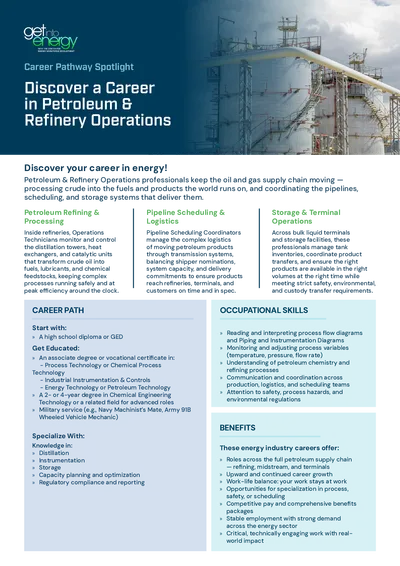
Petroleum & Refinery Operations
(Click to download)